
“There is no credible election without a credible media, and no democracy without both,” CEMESO Executive Director Dr. Akin Akingbulu declares in Osogbo, as EU-SDGN II Component 4 partners charge the media on voter education, fact-checking, inclusion and the watchdog role.
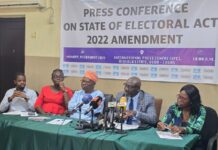
With barely five weeks to the off-cycle governorship election of 15 August 2026, the Centre for Media and Society (CEMESO) and the International Press Centre (IPC) on Thursday convened a high-level media engagement and stakeholders’ interface in Osogbo, under Component 4 (Support to Media) of the European Union Support to Democratic Governance in Nigeria, Phase II (EU-SDGN II), with a clear charge to the media and electoral institutions: give Osun — and Nigeria — an election to be proud of.
Delivering the welcome address at the engagement, held at Aenon Suites & Hotel, Osogbo, the Executive Director of CEMESO, Dr. Akin Akingbulu, said the gathering had convened at a moment when “the eyes of Nigeria, and indeed of the democratic world,” are turning towards Osun State, whose place as the only state on the ballot this August concentrates the full intensity of national political attention, resources and rivalry on a single contest.

Dr. Akingbulu anchored the intervention firmly in the objective of the EU-funded programme’s media component — to ensure that the media, including new and social media, provides fair, accurate, ethical and inclusive coverage of the electoral process — and paid tribute to the European Union, “whose generous funding and steadfast commitment to democratic governance in Nigeria make this intervention, and many others across the electoral cycle, possible.”
“Our conviction is a simple one,” he declared. “There is no credible election without a credible media, and no democracy without both.”
Setting out the scale of the task, the CEMESO Executive Director noted that about 2.33 million registered voters and thousands of election personnel would be engaged across Osun’s 30 local government areas, 332 wards and more than 3,700 polling units — logistics he described as formidable — while evidence gathered from journalists across the state under the programme had identified the political environment and misinformation as the two highest-rated threats to press freedom, alongside economic pressures, editorial interference and a climate of rising fear.
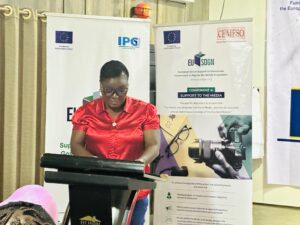


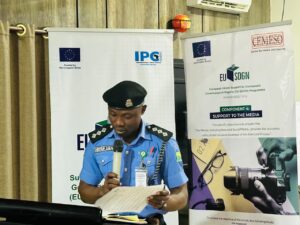
Drawing on the programme’s recent deployment of trained journalist-observers for the 20 June governorship election in neighbouring Ekiti State, Dr. Akingbulu warned against assuming that Osun would simply replay Ekiti. “The contest here is keener, the polarisation deeper, and the stakes, for the actors and for the system, considerably higher,” he said, calling — “respectfully but firmly” — on the electoral commission, the police, the civil defence corps, the orientation agency, the professional unions and the media itself to heed the voice of duty. The answer to the security concerns hanging over the election, he insisted, “is not silence but professionalism: neutrality from the security agencies, transparency from the umpire, restraint from political actors, and accurate, conflict-sensitive reporting from the press.”
He thereafter set four urgent tasks before the media: to make civic and voter education a daily editorial commitment between now and 15 August, supported by the CVE Toolkit developed under the programme; to make fact-checking a newsroom routine rather than an afterthought, aided by the AI Fact-Checking Guide launched under the programme — “Verify before you publish. Attribute before you amplify,” he charged; to open the door of coverage to women, young people and persons with disabilities, applying the programme’s Gender-Sensitive Media Guidelines; and to discharge the watchdog role over every electoral institution “with accuracy, balance, fairness and conflict-sensitivity, for the watchdog that barks falsely soon loses the public’s ear.” He urged journalists, above all, to prioritise their own safety, assuring them that the programme’s mechanisms for monitoring and responding to attacks on the press stand ready to serve them.
Dr. Akingbulu also recalled that citizens who participated in the Voter Opinion Lab, convened in Osun under the programme with The Kukah Centre, had spoken plainly of their worries about vote-buying, the monetisation of politics, insecurity and the cost of living, and had demanded campaigns built on issues and manifestos rather than insults and inducements. “Those citizen voices are, in truth, the real brief for this engagement,” he said.
In his welcome remarks, the Executive Director of IPC, Mr. Lanre Arogundade, situated the convening within the delivery record of the Component in Osun State, disclosing that the partners had, ahead of the engagement, facilitated the emergence of a corps of electoral fact-checkers in the state; conducted a public opinion poll on priority election issues; trained 15 state Voter Education and Publicity officials in digital literacy and fact-checking, leading to the establishment of a six-person INEC fact-checking unit; trained 40 INEC state officials in information management and crisis communication; and built the capacity of 25 print and online journalists on issue-oriented reporting of the Osun poll — all made possible, he noted, by the funding support of the European Union.
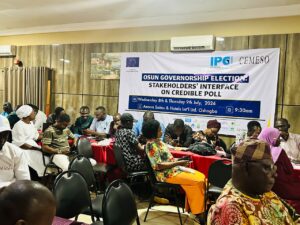
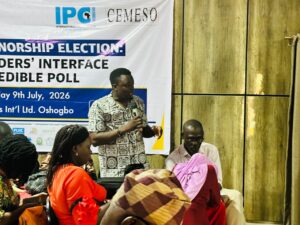
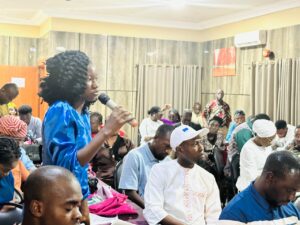

Mr. Arogundade underscored the strategic weight of the poll as the second off-cycle governorship election under the Electoral Act 2026 — a fresh test of the mandatory electronic transmission of results to IREV — and the last major election before the 2027 general elections, whose credibility could significantly shape public confidence in the new INEC leadership. Urging participants to engage in “dialogue, not monologue,” and to act as “genuine stakeholders, not mere placeholders,” he charged all institutions present to state their level of readiness, affirm their willingness to be held accountable for their commitments, and pledge openness to criticism. “No single tree makes a forest,” he said. “Together, we can make Osun State a stronghold of credible electoral conduct and an outcome acceptable to all.”
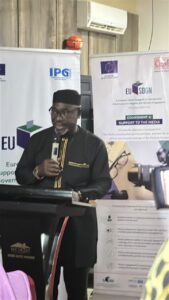
The engagement drew the Osun State Resident Electoral Commissioner, Mrs. Oluwatoyin O. Babalola; the Commissioner of Police, Osun State Command, CP Ibrahim Gottan, represented by the Command’s Public Relations Officer, DSP Ojelabi; the State Commandant of the Nigeria Security and Civil Defence Corps (NSCDC); the State Director of the National Orientation Agency (NOA), Mr. Adebiyi Adefarasin; the Chairman of the Nigeria Union of Journalists (NUJ), Osun State Council, Dr. Adeyemi Aboderin; the Chairperson of the National Association of Women Journalists (NAWOJ), Osun State, Comrade Bisola Ariwodola; and editors, reporters, producers and presenters drawn from the broadcast, print and online media.
The partners announced that the Osogbo engagement is one station on a longer journey, with further EU-SDGN II interventions in the pipeline before election day, including breakout capacity sessions for print, online and broadcast journalists, a pre-election assessment of the Osun electoral environment, and a citizens’ town hall.