
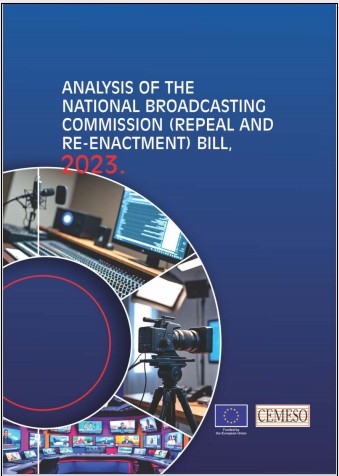
The National Broadcasting Commission (Repeal and Re-Enactment) Bill, 2023 (SB 134), sponsored by Senator Eze Emeka Kenneth, seeks to replace Nigeria’s existing National Broadcasting Commission Act with a modern legal framework capable of responding to the rapidly changing broadcasting and digital media environment. Introduced in the Senate in October 2023, the Bill is designed to address developments such as digital broadcasting, internet-based media, spectrum management and the convergence of broadcasting and telecommunications.
Among its major proposed reforms is the introduction of a dual licensing system, separating broadcast content provision from signal distribution. The Bill also provides a legal framework for Nigeria’s transition from analogue to digital terrestrial television and proposes a Digital Access Fund aimed at improving digital broadcasting infrastructure and access, particularly in underserved communities.
The proposed legislation would also expand the NBC’s regulatory mandate to cover webcasts, Over-the-Top (OTT) services and other online broadcasting platforms. It seeks to strengthen enforcement by giving the Commission powers to impose sanctions, revoke licences, issue content takedown orders and inspect broadcast facilities and records.
The Bill further emphasizes media plurality, local content, fair competition and inclusion, including greater attention to women, young people, persons with disabilities and community broadcasting. It also proposes measures to support professional development within the broadcasting sector.
However, the analysis identifies significant concerns that could undermine the Bill’s objectives if left unresolved. A central issue is the level of ministerial and executive influence over the NBC. Board members would be appointed by the President on the recommendation of the Minister, while the Minister would retain significant powers over appointments, policy directives and licensing. According to the analysis, this could weaken the Commission’s operational independence and create opportunities for political interference.
The report also raises concerns about the regulation of online content. Although extending regulation to digital broadcasting reflects technological realities, the Bill does not clearly define terms such as “webcast” and “online media platforms.” This creates uncertainty over whether its provisions could extend to social media users, user-generated content and other forms of online expression, potentially creating risks of regulatory overreach and conflicts with freedom of expression.
Another major concern is due process. The Bill gives the NBC broad enforcement powers, including licence revocation and content takedown orders, but the analysis argues that it does not provide sufficiently detailed safeguards on hearings, appeals, timelines, written decisions and judicial review. The report therefore recommends stronger procedural protections for broadcasters and other affected parties.
The analysis also highlights weaknesses in the licensing framework, including a lack of transparency and the continued involvement of the executive in final licensing decisions. It recommends clear and objective criteria for licensing, renewal and revocation, as well as greater public disclosure of licensing decisions.
To address these concerns, the report recommends strengthening the NBC’s independence through merit-based and transparent appointments, stakeholder consultation and National Assembly confirmation of key appointments. It also calls for clearer limits on ministerial powers, stronger appeal mechanisms, clearer definitions for digital regulation, improved licensing transparency and greater public participation in the development of broadcasting regulations.
Overall, the analysis concludes that the Bill represents an important opportunity to modernize Nigeria’s broadcasting regulatory system, particularly in response to digital transformation. However, it argues that the legislation requires substantial refinement to ensure that regulatory effectiveness does not come at the expense of media freedom, institutional independence, due process and citizens’ constitutional rights. A successful framework, according to the analysis, should balance effective regulation with innovation, competition, public access and the protection of diverse and independent media.