
PRESS RELEASE
13 February 2026
Lagos, Nigeria
CEMESO Commemorates World Radio Day, Reaffirms Radio’s Democratic Role Amid AI Advancements
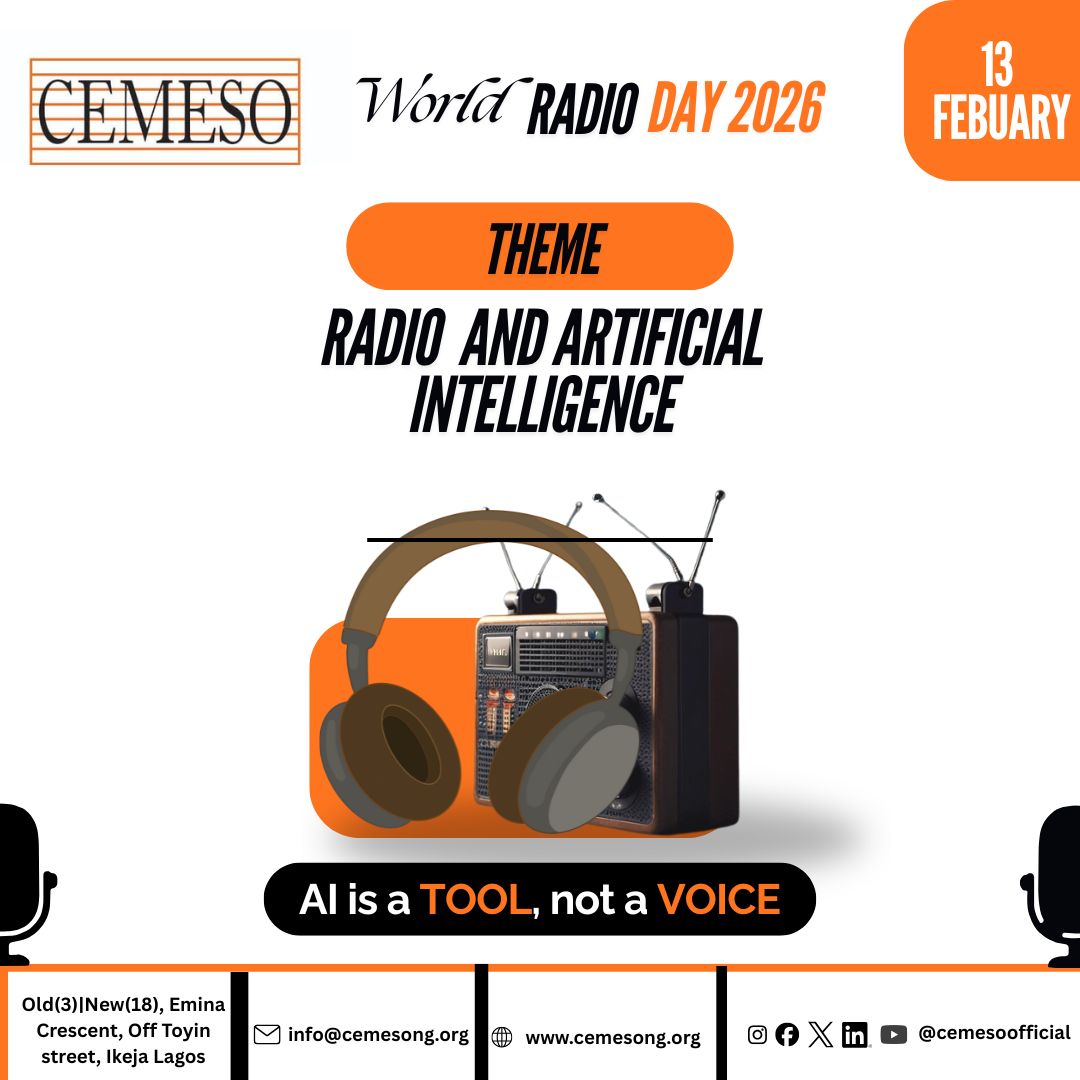
As the world marks World Radio Day 2026 with a focus on radio and artificial intelligence, the Centre for Media and Society CEMESO, reiterates that radio remains one of the most powerful democratic infrastructures in Nigeria and across the world—enduring, adaptive, and indispensable, even as new technologies reshape the global media landscape.
Speaking on the significance of the day, The Executive Director of CEMESO, Dr. Akin Akingbulu stated that “radio is not a relic of the past; it is Nigeria’s most democratic medium. Its strength lies in accessibility, trust, and proximity to everyday life. As artificial intelligence enters the broadcast space, the task before us is not to abandon radio’s human foundations, but to strengthen them through responsible innovation.”
In a country where radio reaches more than 77 per cent of adults weekly, penetrates rural and low-income communities beyond the reliable reach of television and the internet, and communicates in the languages people live their lives in, radio continues to function as a living public good. More than 80 per cent of households own a working radio, and even among young people—often assumed to be digitally exclusive—radio listening remains remarkably high. This reach explains why radio has remained central to Nigeria’s development experience for decades.
Yet this year’s World Radio Day comes at a moment of deep contradiction. Nigerian radio operates with extraordinary public trust, but under persistent financial strain, regulatory complexity, and infrastructural fragility. Despite these constraints, radio continues to deliver tangible development outcomes, in such sectors as health, education, agriculture/food security, among others. These interventions underscore radio’s unmatched capacity to serve as a bridge between policy intent and lived reality.
Artificial intelligence now enters this ecosystem with both promise and risk. From automated transcription that expands access for hearing impairment audiences, to predictive scheduling, audience analytics, and cost-efficient playout systems, AI tools can help radio stations do more with fewer resources.
However, as Dr. Akingbulu cautioned, “we must be clear-eyed about the risks. Automation in a financially fragile sector raises legitimate fears about job displacement. Algorithmic bias can erase minority languages and marginal voices if left unchecked. And the misuse of synthetic content can deepen misinformation at a time when public trust is already under strain.”
CEMESO notes with concern that without deliberate safeguards, AI adoption could widen existing inequalities within the broadcasting sector—concentrating power among wealthy, urban stations while further marginalising community and campus radios that remain the closest to grassroots realities. This would undermine radio’s historic role as a forum for civic dialogue, local accountability, and inclusive participation.
Radio’s enduring relevance lies in its human core—presenters who embody community identity, producers who understand cultural nuances, and journalists, who earn trust through consistent presence. Artificial intelligence must not displace this inheritance; it must serve it. As Dr. Akingbulu further observed, “AI should augment radio’s public service role, not hollow it out. Innovation that silences local voice or weakens editorial independence is not progress—it is regression.”
CEMESO therefore calls for coordinated and responsible action. Policymakers must use the ongoing review of Nigeria’s broadcasting framework to modernise regulation for digital convergence and AI, while easing disproportionate licensing and compliance burdens on non-profit and community stations. Broadcasters must commit to transparent and ethical AI deployment, investing in retraining and upskilling workers rather than discarding them. Development partners and donors must recognise radio not merely as a delivery channel, but as a strategic democratic institution worthy of sustained investment, including support that makes AI tools affordable and accessible for under-resourced stations. Civil society and media organisations must continue to defend press freedom, because without editorial independence and public trust, no technology can safeguard radio’s democratic function.
World Radio Day 2026 is not about choosing between tradition and innovation. It is about insisting that innovation serves justice, inclusion, and human dignity. Radio has survived colonial rule, military dictatorship, economic shocks, and technological disruption because it belongs to the people. If artificial intelligence is to shape radio’s future, it must be guided by that same principle. A future where radio remains accessible, trusted, locally rooted, and technologically empowered is not only possible—it is essential for democratic life and sustainable development in Nigeria and beyond.
Media Contact:
Timothy Bamidele
Programme Manager
Centre for Media and Society (CEMESO)
tbamidele@cemeso.org
+234 805 654 4562
Download Press release here